

“Look, look, that’s Tsvetana’s boy,” my father recalls some old Bulgarian village women whispering, pointing at him as he walked by. My grandmother was kind of a legend in her own time. One day, she’d disappeared. Soon after, two cops knocked on my grandfather’s door and said something to the effect of, “Did you know that your wife has been having an affair with an enemy of the people and just illegally crossed the border with him to the West?”
Pretty good gossip for a small Bulgarian town in the 1960s. People never even got divorced. They certainly didn’t risk getting shot at the border to run away to America with their boyfriend. The older neighbors in their building in Sofia also remember like it was yesterday. My mom observed once that women spoke about my grandmother with a mix of reverence, awe, a flicker of, “Why can’t I escape this stupid, poor country and my fat drunk husband1 to run away to America with a handsome lover?” Then they’d be hit with the weight of leaving an only child behind.2
There were repercussions! The social stigma and shame. My great-grandmother, a no-nonsense, sturdy village woman, had a nervous breakdown and had to be hospitalized— people just did not do what her crazy, wild daughter had done. My great-uncle had to check in with the authorities every week. Had it not been for my grandfather’s connections—he was a big building contractor—my father may have been barred from University. As it were, he wasn’t allowed to teach students lest he impart Western imperialist ideas. It was unjust, even in these small ways, to punish a child for his mother’s actions.
Still. No one put him—much less me—in jail for what my grandmother had done, and what she’d done was a big deal: the Soviet satellite states banned emigration and violently restricted border crossing. Guards could shoot on sight. Central to the regime’s ideology was that they’d built a Communist Utopia no one would dream of leaving and people like my grandmother and step-grandfather punctured the narrative. Meanwhile, the West cast “escapees”— refugees from the Soviet states—as avatars of Western superiority, risking their lives for Freedom. Unlike today, romanticizing refugees made for pretty good propaganda during the Cold War.
***
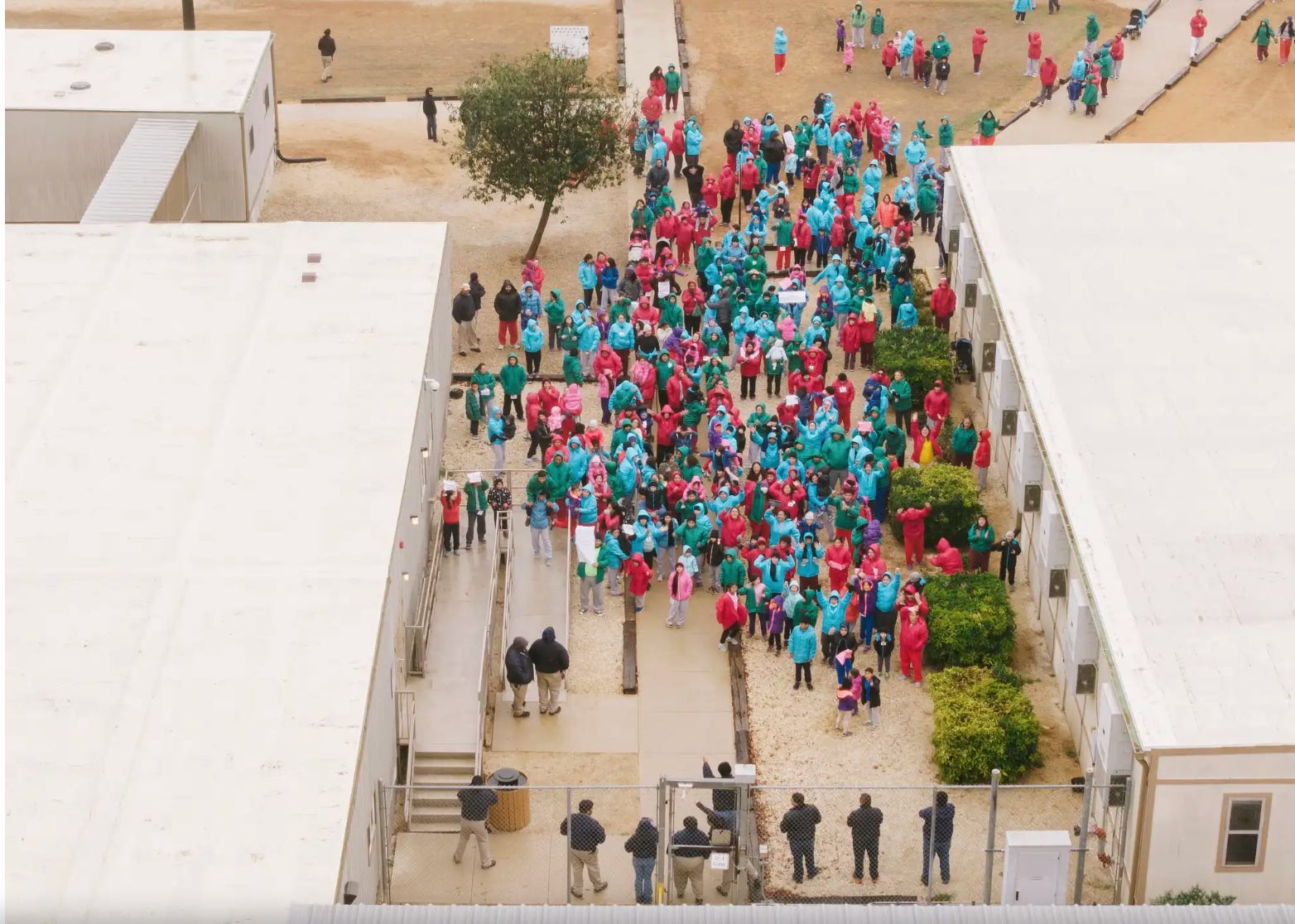
There is a 16-year-old boy in jail in Texas, who immigrated to the States, his mother writes in a piece in the Nation, when he was pre-K. He and his mother, professor Maryam Tahmasebi, have been detained in the “Dilley Immigration Processing Center” since April—his father is held in a separate ICE facility.
Before I continue: enough with the fucking euphemisms. It’s not a “processing center.” It’s a prison. In a damning detail, Tahmasebi notes that the family has asked to be deported—even though the boy only speaks English—but they’re still being held. They’ve been in jail for 120 days. Every two weeks they’re allowed a 10 minute phone call with the father. They’re in jail because half a century ago the boy’s grandmother—his father’s mother—was an English translator during the 1979 hostage crisis.
The family was doxed by online right-wingers. Secretary of State Marco “my family fled Communism oh wait whoops actually they came to America before Castro and also my grandfather was in the country illegally” Rubio revoked the family’s visas without warning and they were arrested by ICE.
“It’s bloodline punishment,” Tahmasebi writes.
***
In a nationalistic frenzy—say after Pearl Harbor, 9/11—legal and human rights naturally erode. It’s just how humans work. The Japanese internment camps. Post-911, the FBI spent like half its time spying on Mosques and tricking dim-witted teenagers into fake terror plots.
But the war with Iran has not triggered a public hysteria stigmatizing Iranians. With the exception of Iranian monarchists, Israel, Laura Loomer, and the administration, the war has flummoxed or angered most Americans. Recent polling found that six out of 10 Americans oppose military action in Iran. Headlines regularly tie the war to rising gas prices. Why would the U.S. public support war with Iran? How much time does the average American voter spend thinking about the 1979 hostage crisis?
So I’d get if they were pandering to widespread public sentiment. But in the absence of public outrage and mass calls to pitchfork Iranians, Rubio still did this. He still did it. He did not have to do it! There was no groundswell of public demand that would help him beat out JD Vance ahead of 2028.
Most Americans who aren’t online right-wing incels are decent people. I would guess that almost all, if presented with the details of this case, would scratch their heads and wonder about why it’s happening in their idea of what America is supposed to be.
***
I’ve found over the years that the psychological mechanism people deploy when presented with some atrocity in the criminal justice system is, “Well, they must have done something bad.” “Well, they did break the law …” I, obviously, staunchly disagree, but you could make the case that someone who sold weed before it was legal may have had risk-taking, anti-social tendencies, that would predispose them to dangerous crime as well.
But in this case? There’s just nothing that any reasonable person can hang their denial hat on.
So let’s put on Laura Loomer face for a moment and try to make the case for this atrocity from the perspective of an evil fascist troll: OK, maybe the son of the translator during the 1979 hostage crisis shouldn’t be enjoying the perks of life in America. Maybe, his wife should have known what she was getting into and publicly denounced her mother-in-law!
But the boy? I’m sure friends or family would take him in and he could at least resume school, regain a small shred of normalcy. If he came here pre-K—that’s even younger than I came to the States, and I’m so culturally American that people in Bulgaria think I’m simple because I smile too much. This is an American teenager held in a US prison for something his grandmother did when she was 19.
It doesn’t even make sense from a “the cruelty is the point” perspective. “The cruelty is the point” did scare away people from massing at the border. There is not a large influx of the family members of people linked to the hostage crisis of 1979.
You really do have to wonder what their plans are when they’re doing something this insane without even any clear political gain. I know “first they came for the …” is a cringe cliche of Boomer Facebook memes but I mean … they just came for two professors and an American teenager.
My grandfather was neither of these things. I loved him, and to this day my grandmother can’t explain what she found so objectionable. He had a great job and their own apartment in the city, a million girlfriends after my grandmother left him, but he never remarried and when he’d visit us in California he’d make me call Grandma and listen in on the other line just to hear her voice.
To be fair to Grandma they did plan to kidnap him, but failed, and here we are!
“Most Americans who aren’t online right-wing incels are decent people.”
Tana, deep down you know this isn’t true. I know very well why you and other left-wing folk want to believe this as it’s necessary for socialism to function. But it’s not true. America is filled with mostly indecent people. And this is true in all countries as most people are terrible.
Don’t delude yourself that corporatist Democrats are any better. You know they aren’t. You know most of them just pretend to care about working people. And you surely know *plenty* of terrible people in left-wing land, and how lots of activists don’t real believe in what they’re doing and just want to benefit themselves.
Tana, my experience of both Right and Left is that most of the “activists” involved on both sides are really more doing it as part of their lifestyle and in order to fuel their ego rather than out of genuine concern for the people they claim to advocate for.
Principled leftists like you are as rare as finding principled conservatives in the right-wing media world that I used to inhabit.
Want to know my estimate for how many Americans are actually decent? 10-15%. And that’s me being more generous than I usually would.