
No, AOC, don't do this.

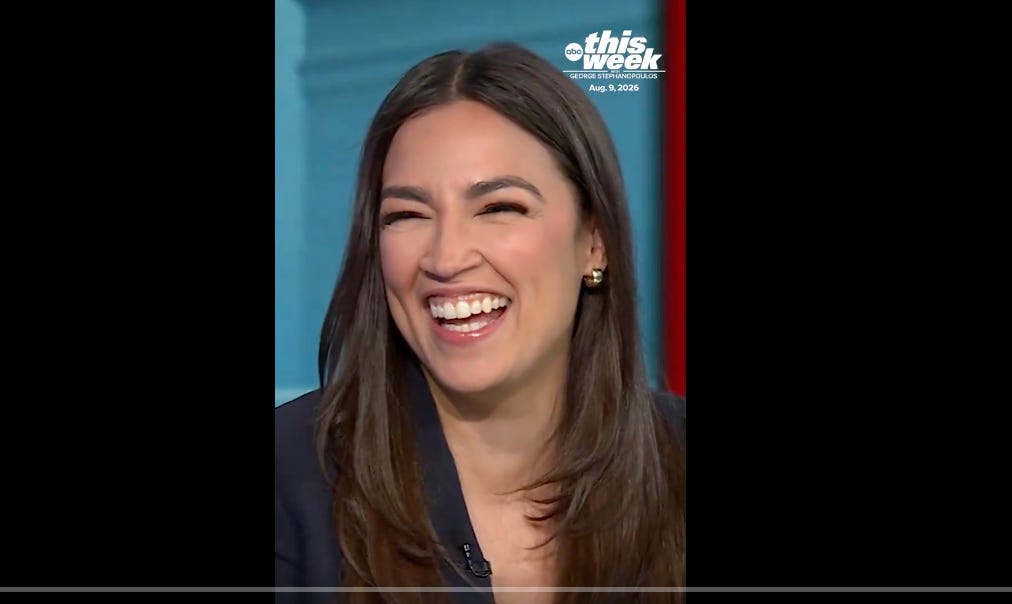
“I have a local city councilman that uh has this saying, ‘Woke 1 was crazy,’” AOC says in a recent viral video clip, stretching a massive smile like she’d been practicing Mamdani in the mirror, then cackling, “HAHAHAHAHAHA!” in a cringey way that kind of reminds me of Kamala Harris screaming “JOY!!!” at people.
The interviewer goes on to ask her about the “defund” movement in particular: the call to “abolish” prisons and “defund” police departments. She disavows it, says it was the result of everyone going a bit crazy in the pandemic (literally pathologizing it!) and that, no, she wouldn’t take these stances today.
But BLM, defund, and abolish preceded the pandemic. The only link to the pandemic is that right-wing, Manhattan Institute types, with 0 empirical proof, insisted that the spike in crime during COVID was the result of the defund/abolish movement.
There’s a much more obvious answer: crime shot up because everyone went insane. A U.S. Transportation report found that even though Americans drove far less during the pandemic, the highest number of people—38,680—since 2007 died in traffic fatalities, a 7 percent increase from pre-pandemic. I don’t think college kids chanting “abolish prisons” caused this.
***
What is “Woke 1” to which AOC refers? It was a constellation of issues, vaguely linked: so-called political correctness, BLM and a major focus on race, they/them pronouns, #MeToo, fat acceptance for women, and outrage at police and prison abuses that coalesced around the terms defund and abolish.
Let’s do a brief rundown of the cultural moment before we come back to AOC. The “policing” of language could be obnoxious. But I don’t think being allowed to mock fat women and say “retard” on Twitter advances us as a civilization. What made me want to tear my hair out was terms like “Twitter jail”—a social media addict’s brief suspension from the Hellsite. Or the horror and outrage of someone “being cancelled” for bucking the pieties of the era. A brief derailment of an upper-middle class career can be psychically and financially ruinious, sure. But not really, when you think about the “cancellation” of a 40-60 year long prison sentence for a pot sale, as Michael Thompson was.
BLM’s centering of race was essential; but there were a lot of grifters. And as a criminal justice reporter I found it counterproductive that the movement (not everyone obviously)—in being almost entirely focused on race—largely erased white poor people, who do not fare that much better in the criminal justice system: think stacked gun and drug charges for meth and opioids.
And, well, the framing of “defund” and “abolish” was a mistake, because the right—and some irritating “contrarian” leftists—gleefully turned what were actually sound, absolutely vital policies, into, “No one picks up when you call 911 and they’ll release every prisoner tomorrow.” There was a very large contingent across the political spectrum that ensured the movement would be associated with the dumbest, least informed people who embraced it—then they held them up as avatars of the ideas, instead of, say, the brilliant Alex Vitale and his seminal “The End of Policing.”
To briefly sum up how I, at least, envisioned the policies. America doesn’t have prisons in the sense of, institutions that rehabilitate people who have committed dangerous crimes, in humane conditions, until they no longer pose a threat to public safety. America has revenge torture pens. You know what’s crazier than “Woke 1, hahahahaha'?” Kalief Browder killing himself after being tortured on Rikers for three years after he was falsely accused of stealing a backpack at 16.
“Abolish prison” never meant sprinkle fairy dust on humanity so that no one does anything bad ever again and every prison shuts down tomorrow—but that’s how it was painted. To me, it meant Scandinavian prisons: comfortable places where you’re still being punished, because freedom is one of the biggest things to lose, but like … you have your own room and a writing desk and you can go outdoors whenever you want and there’s yoga.
Defund the police? No one suggested you cut off all funding to police. And no one actually cut a dime of funding to police. What I was thinking was at the time, I was doing a lot of reporting on the NYPD. 10 percent of cops had CCRB complaints against them in the double digits, also costing the city millions in related lawsuits. You think, “OK, lets “defund” these 10 percent who spend their time slamming teenagers’ skulls into the pavement.
The main point binding defund and abolish was that these institutions have 0—I mean literally no—incentive to reform and self-police. I’m pretty sure a friend who worked at the CCRB (Civilian Complaint Review Board, NYPD “watchdog”) has a rage ulcer from writing up endless reports that went nowhere.
The point of the “extreme” rhetoric was to spur real, concrete reforms in institutions that had shown again and again they wouldn’t.
And then everyone just kind of forgot. It’s no longer politically expedient to profess alarm about the criminal justice system, so most politicians don’t. I think that’s both an ethical and strategic mistake.
Instead of “Woke 1 HAHAHAHA” followed by word salad about reform and the pandemic, AOC should have said this. “The rhetoric worked against us, because people could spin it as a dangerous lack of common sense that undermined public safety. However, the U.S. justice system is inhumane and in need a serious reform, and we can’t lose track of that even if it’s no longer the “trendy” issue.”
If AOC is going to take a page from Mamdani in her obvious run-up to 2028, it’s not just the smile—it’s sticking to core convictions even if they no longer resonate.
Mamdani? At this point there’s no political upside to centering jail and prison conditions and reform; only the downside of the New York Post printing stories about how much he loves criminals. But he still visited Rikers multiple times and hung out and shared food with people.
Ethics and humanity aside, do it for craven political reasons. Be the politician that doesn’t abandon core principles in your obsessive lunge for power: it goes totally viral.
Just a few banger Darlializa Avila Chevalier quotes:
"Yes, it means ending policing full stop. Period. No more police at all ever."
"Yes, literally, abolish the border."
“A world without borders—just like a world without prisons or police—is possible, necessary, and the only moral way forward."
Lefties can deploy the word salad about how "defund the police" and "abolish prisons" AKSHUALLY means increasing funding to those institutions, but no one is forgetting the fever dream that created by an army neurotic women and far-left lunatics, including AOC. It's never too late to admit you were wrong.
I'm a supporter of neither policing nor corrections as we (in Canada and the US) conceive of and practice them, but I also think your piece demonstrates quite clearly why the "defund" tag was mostly a waste of energy and wilfully misdirected, even at working class racialized communities. For the moment here, I'm not concerned with your take on AOC. But the fact that you need to translate and reframe the best demands and intentions of "defund" kind of says it all. The branding, the hashtag, carried its own, undeniable connotations and rhetorical position. Advocacy for prison and policing reform (that is, the demand for more community based and non-violent law enforcement, and for legitimately humane and rehabilitative prisons) is quite old, and the "defund" movement can be reasonably seen, I think, as both an extension of that history of advocacy, but also as a scuttling of it. AOC could have done a better job of responding to be sure, but saying so submits her to the same kind of analysis (which you engage in, I think) that would argue that "defund" should have picked a better hashtag, and maybe even lost an opportunity.